


Lakota Times Article, June 3rd, 2026


“When those challenges come up to us we try to be like the buffalo…… put our heads down and walk into the storm.”
June 03, 2026
Full Article Link: https://www.lakotatimes.com/articles/when-those-challenges-come-up-to-us-we-try-to-be-like-the-buffalo-put-our-heads-down-and-walk-into-the-storm/

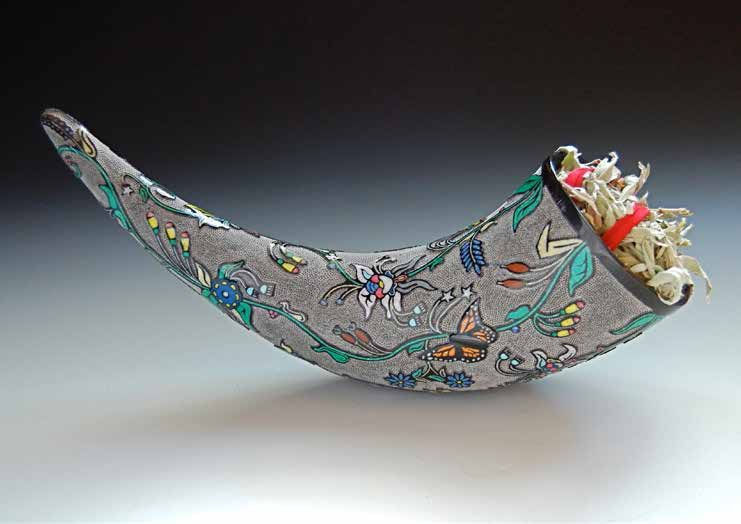
Buffalo horn and horse mask artistry are unique crafts primarily done by a few individuals. Attempts are being made to encourage others to continue carrying on the tradition so it isn’t going to be lost.
Kevin and Valerie Pourier are citizens of the Oglala Lakota Nation. The Pourier’s live on the north side of the Pine Ridge Indian Reservation in SD on an old bombing range the Air Force made back in the 40’s. They have lived on the same land for four generations.
The Pourier’s named their studio the “Bombing Range Art Studio.”
Kevin Pourier recently earned multiple honors at the Heard Museum Guild Indian Fair & Market 2026. These included “Best of Class: Diverse Art Forms,” “First Place,” and two “Judges’ Choice Awards.” His extraordinary artwork, “Protects the Spirit” Horse Mask was created in collaboration with master beadworker and quill artist Juanita Growing Thunder, Fort Peck Assiniboine/ Sioux.
The Heard Museum in Phoenix, AZ is one of the most prestigious platforms for Native American art; it is also the largest art market in Arizona and one of the largest Native art markets in the country. The event featured hundreds of juried Indigenous art creators.
Pourier also won “First Place” and “Best of Division” at the Heard Museum Guild Indian Fair & Market 2019 for “Warrior Women II, Finding Their Voices” Native women politicians. This was for a Buffalo Horn Belt.
The 97th Annual Santa Fe Indian Market 2018 also bestowed upon the Pourier’s the “Best of Show” and the husband and wife artists work collaboratively to create wearable artwork as well. Also in 2018, they received the “Judges Choice Award” for the “Floral Buffalo Horn Glasses” at the 60th Annual Heard Museum Guild Indian Fair & Market.
According to Pourier’s website, “Protects the Spirit” is more than a work of art – it is a living expression of indigenous identity, protection, and reverence for the horse as a spiritual partner.”

Kevin Pourier recently shared answers to questions from Dan Ninham about his unique craft of buffalo horn artistry.
DN: How do you sustainably and respectfully source your buffalo horns, and what is your relationship with the material before you begin carving?
KP: Many of the horns I get come to me when I least expect to get a horn. A lot of the horns come from people here who have ceremonies and will give them to me knowing that I make things out of them. Many times I get them from processing plants that throw them away in landfills. So, I feel good that I am saving as many as I can and am able to make beautiful things from them. Every horn I have ever gotten is smudged and prayed over to honor and thank that buffalo Spirit.


DN: A buffalo horn is an incredibly dense, challenging material. Walk us through the stages of your creative process— from cutting and carving to the sanding and polishing?
KP: When I started to work with buffalo horn there was no one else that I knew of using this material. I knew a few artists that were carving on elk and deer antlers but never the buffalo horn. So, every stage I had to learn “by doing”. Like the inside of the horn is a different texture than the outside. The tip is more dense than the base. Even the inside of the curve is different than the outside.

I only use horns from a bull buffalo and they have to be a certain age for me to be able to make the larger pieces that I make. So, out of 10 horns that I get maybe only two are usable for me. When I begin to work with a piece I first start by using an old grinding wheel that my grandpa used to sharpen his knives on his hay cutting sickle to take off the rough outside. I’ll use a bandsaw to cut the horn into pieces that I can use.
I draw my designs and use a carving burr to carve into the horn. There are really so many steps to making a piece it would take me 10 pages to go through every step. To keep it short I cut, carve, sand and polish.
DN: The contrast between the dark horn and inlay materials is striking. How do you decide what natural materials (e.g., crushed stone, shell, sand-stone, Mother of Pearl) to incorporate into your work?
KP: I suppose it’s pretty much like a painter would decide what colors work well together. My main material I use is Mother of Pearl. I can mix the white pearl with any earth color and come up with an unlimited number of shades of any color.
DN: You often transition between different types of pieces, such as from jewelry and earrings to larger items like cups, ladles, or traditional spoons. How does the scale change your approach?
KP: In the beginning of my art career I just made small earrings and pendants. In my first art show I entered I put in a pair of earrings and won a second place ribbon. I didn’t plan on entering anything so I just put in what I had. After, I thought I can make something way bigger. So, I made a necklace that had three or four pieces and from there I just kept going bigger and bigger adding more and more.
The art shows I attend now have artists entering large sculptures, textiles that cover a whole wall to gold pieces valued in the thousands of dollars. It’s hard to have a small horn spoon or horn cup to even get notice so now my big show pieces include many pieces to make large belts or I make a series of spoons or cups that display a larger presence at a show or museum.
DN: Buffalo horn carving is a historic Plains art form. How do you view your work in relation to the craftsmanship of your ancestors, and how does it keep those traditions alive?
KP: At one point when I started entering shows and winning awards there was one southwest show that questioned my inlay work. And there was even a new standard that was made that disallowed the ‘inlay’ that I was using. I was determined to not give up on the art I was making so I set out to document that what I was making was according to the same things my ancestors had made.
I applied for a research fellowship with the National Museum of the American Indian in Washington DC. I was accepted and researched all horn carvings in museums up and down the East Coast for three weeks. The things I saw in all those collections made a big impact on me as a Lakota and artist.
Some of the horn spoons that I saw were highly polished and half were decorated with quillwork and beaded handles. I was amazed at the amount of work it must have taken to achieve that smoothness and shine having only simple tools. Today, I have modern tools and polishing machines and tell myself that if a spoon or cup or adornments could’ve been made so beautifully back then there is no excuse for me to make shabby work.
I push myself to make the most flawless piece in everything I make. In the Smithsonian collection I saw a horn cup that had been inlaid with a dark blue earth color. It was labeled as being made by Crazy Horse. This piece confirmed to me that I had been making things in the same manner as my ancestors have for centuries.
Years later I was back in the collections at the NMAI and was looking at the spoons again and one drawer I opened was a spoon I had made that the museum had purchased. Inside was old spoons from the 1800’s and next to these amazing pieces was the one I had made. I was so moved to think that something I had made was right next to the historic pieces. I really felt like I was continuing a tradition at that point.
DN: In many Indigenous cultures, the buffalo is highly revered. Can you share the significance of the buffalo Oyate (family) and its spirit within your daily life and artwork?
KP: I didn’t start making art as a career until I was 30 years old. This was when I had to change my life by becoming alcohol and drug free. I was searching out many questions about myself that I never thought about. Who was I, where am I from, am I a part of anything, and what do I do. I started participating in our Lakota ceremonies with my cousin who was also searching.
Learning everything I could and taking in all the teachings saved my life. My changes happened to me during this time that led me to walk the Red Road. The buffalo of course was then and still is the Center of Lakota spiritual and also life source. I like to say that the buffalo gave life to the Lakota from the beginning of time to today providing me and my family a way to live. I never take for granted that the material I work with is such an integral part of my life today was it was in the past to my ancestors.
This material has taken me and my wife, Valerie, on the most amazing journey. We have met some of the most creative people in the business, traveled to and seen some of the most amazing things all because of, I believe, that I honor that Spirit of the buffalo every day.
DN: Were there specific mentors, family members, or elders who guided you, or was your learning process based on personal exploration and museum research?
KP: I think that living an alcohol and drug free lifestyle has lead us to come into contact with many of the people who take this artist life seriously. I never could have gotten to the level I am as an artist being a party guy. Since I am the only artist who works solely with buffalo horn I honestly didn’t get much support. People really didn’t know what I was trying to do.
I was told to use German silver, I was told to do mosaic work and also to try sculpture. Everything I have learned today has been by trial and error. There was no teacher for the art I make, or store to get my materials. I sometimes think I must be crazy working solely with the horn but if I had to do it all over again I would probably do it again. I do have an awesome group of artists we hang with today that are at the top of the artist game. We give each other support and talk about what we are doing and what we can do for our communities and young people to make Native art as important as any other art in the world today.
DN: There can sometimes be an expectation that Native art should only recreate historical forms. How do you push boundaries to ensure your work speaks to the modern, 21st-century world?
KP: I never went to art school and so don’t follow very good as to what I am expected to make. I see many western artists and also many Native artist’s exhibit paintings that are based on that romanticized imagery of Indians chasing buffalo, tipis in the mountains and all that. It’s decorative I suppose. As for me I am living in the 21st Century and being a contemporary Lakota man I experience many things that we all do today.
Who are we? Identity, loss of our ways, injustices in Indian Country. I love to make pieces that aren’t racist but deal with behaviors we all deal with as humans. Subjects that make us all, no matter what race we are part of, look at ourselves. Being of mixed race I experience hateful behaviors from both Native and non-Native sides. I like to turn the tables on art from the past that doesn’t jive with who we are today.
Like ‘The End of the Trail’ sculpture I put a cavalry guy on the horse holding a flag surrounded by Lakota warriors. Seeing the reactions of people who see that piece and realizing that when things are turned around makes them look at things in a different way. My political pieces create a conversation that leads to educating, understanding and hopefully healing.
DN: What kinds of contemporary issues, political statements, or personal narratives do you weave into your carved designs?
KP: I don’t think for a minute that I speak for anyone else by myself. I have my own story to tell as a Lakota man living in the 21st Century. I have actually chased a herd of buffalo on horseback but then the next day sat at a Starbucks the next day telling crazy stories with my artist friends. But, making art that matches people’s color of their walls or carpets is not the kind of artist I am.
DN: When viewers— especially those unfamiliar with Indigenous culture— see your work, what do you hope they learn or feel?
KP: What I’ve seen in my show experience is that so many people think of “Native Art” as something SW artists make like silverwork, pottery, baskets. And then when they think of Northern Plains Peoples they think all we do is live in tipis and chase buffalo. I enjoy presenting to the many people we see at a show is that there are some top art coming of Lakota country.
DN: What milestones in your career— such as fellowships, museum exhibitions, or acceptance into prestigious markets—have been the most meaningful to you?
KP: The research fellowship I received from the Smithsonian National Museum of the American Indian changed my life. Seeing all the beauty and love that went into the things our ancestors made so long ago really moved me. Then, it’s just continuing work as an artist and seeing what comes to us over each horizon. That’s what I’ve enjoyed looking back at the beginning.
First it was winning my first award then, winning a grant, then being accepted into one show after another. Then being part of a museum exhibition and seeing something I’ve created next to the top artists in the country. Mostly, when me and Valerie are having dinners and talks in Santa Fe with some of the top artists in the country. I think of what I’ve had to overcome to get where we are. We have had to pay our dues, work hard, leave home and travel to faraway places and put ourselves out there and mostly all on our own. Through it all, looking back I feel like we have been guided on the most amazing journey. I just have to pinch myself sometimes.
DN: How do you feel the Indigenous arts community has evolved regarding visibility and representation, and what challenges are still being faced?
KP: Seems to be more and more artists are incorporating what it is to be Native in America and more statement pieces. I realize that there were just a few in the 1960’s who were ‘rocking the boat’ and I give them a lot of credit. My community of arts I hang out with day are ‘Boat Rockers’ and am inspired every day. Museums today I think are reaching out more to hear Native voices which is great because it gives a voice which in turn empowers us to create more work that has power. Power to grow, to change and make better for future generations.
DN: Are there dream projects, new techniques, or future collaborations you are currently excited to explore?
KP: The last few years I have had the honor of collaborating with the Growing Thunder family. They are master quill and beadworkers and create highly sought after work by both collectors and museums. We have worked on a series of horse masks that have become part of prestigious museum and private collections. I have really had to push myself to match their amazing work. I am working on my most ambitious piece right now and I am excited about working and pushing myself on this new direction. I have also been approached by other artists recently on making collaborative pieces. Its way cool to work with other artists and have to step outside the path that we have been on to date. It’s weird but I have never really ‘planned’ a path to go on it just happens. It’s been kinda like a dream.
DN: Share any other comments that you would like your readership to know about you professionally and/or personally in your artwork.
KP: I never could’ve made this wild journey as an artist without my wife, Valerie. We work together on our ideas always for our next project. In fact, it was her original concept for an art project that lead to us winning the ‘Best of Show’ award at Santa Fe Indian Market. Also, I never would’ve even tried to or dreamt of doing what we do had I not become alcohol and drug free. It hasn’t always been easy and there’s been the struggles. But when I think of what has led us to here where we now I think of what has always been central to us, the buffalo. When those challenges come up to us we try to be like the buffalo…… put our heads down and walk into the storm.
All photos are credited to Kevin Pourier.
Kevin Pourier’s website is: www.kevinpourier.com and Instagram is: @kevinpourier.


Comments